Introduction
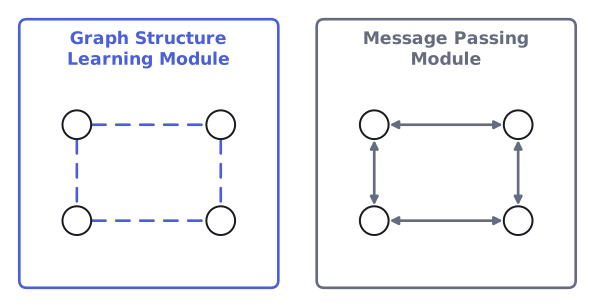
Graph Neural Networks assume a graph is given. In practice, that graph is often noisy, partially known, or missing entirely. Graph Structure Learning (GSL) addresses this by learning or refining the graph jointly with the prediction task.
Take subway traffic forecasting as a running example. The station network is a natural graph, but if the map is unavailable, GSL can recover a working structure directly from passenger data.
More generally, GSL extends graph-based methods to any data where a graph is suspected but not directly observed. The resulting graph can then be used with spectral techniques or, more recently, Graph Neural Networks, which have been applied successfully to social networks (Fan et al., 2019), recommendation systems (Wu et al., 2022), and spatial analysis (Derrow-Pinion et al., 2021).
This article gives a concise overview of GSL: why it is used, how it is combined with a network, and what constraints are typically imposed on the learned graph.
Motivation
Performance
The primary motivation is performance. Framing a problem as a graph problem introduces a useful inductive bias. Learning or refining the graph further adapts the model’s structure to the task, improving results.
Explainability
A second motivation is understanding the system itself. Graphs are easy to visualize and map naturally onto the problem domain. In our subway example, GSL could recover the station network directly from data: the idea behind Graph WaveNet (Wu et al., 2019).
This benefit has limits. As a network grows, the graph it learns may diverge from one a human would draw. MTGNN (Wu et al., 2020), for instance, improves prediction accuracy but produces a graph that is not human-readable. At that point we are analyzing how the network represents the problem, not the problem itself: explainability rather than interpretability.
Robustness
A third use is defense against adversarial graphs. Like any input, a graph can be manipulated to bias a model’s output, for example to favor a particular product in a recommendation engine. GSL can correct such graphs by removing the offending edges, a process Jin et al. (2020) call graph purification.
Implementations
Paradigms
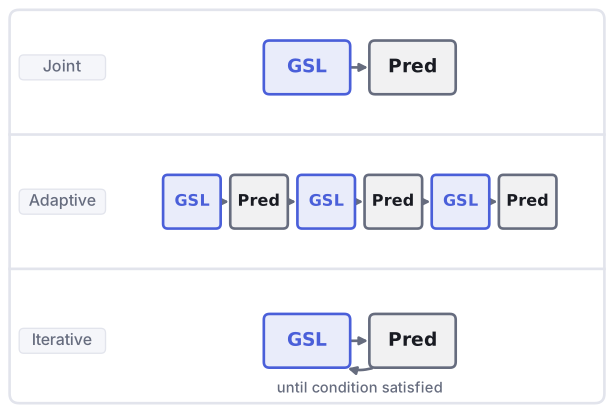
A GSL module can be combined with the rest of the network in three ways.
- Joint — a single GSL block, followed by the rest of the network.
- Adaptive — a fixed sequence of alternating GSL and prediction blocks, as in MTGNN (Wu et al., 2020).
- Iterative — the same idea, but repeated until a stopping condition is met rather than a fixed number of times (Chen et al., 2020).
Constraints on the graph
Learned graphs are usually constrained to preserve properties expected of real graphs. This is enforced either through regularization (altering the loss) or architectural constraints (altering the network itself). We cover the most common attributes below; others exist.
Constraints by regularization
Regularization terms steer the learned graph by adding a penalty to the loss:
Kalofolias (2016) identifies several such constraints.
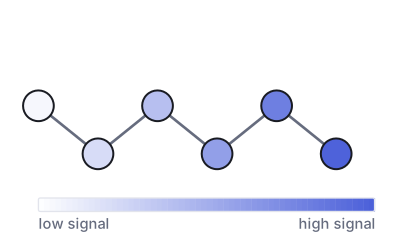
- Smoothness — under a homophily assumption, connected nodes should have similar representations:
Under heterophily, the opposite holds: connected nodes should have distant embeddings.
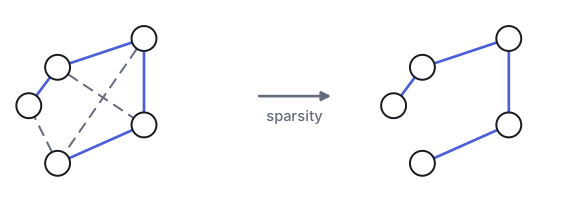
- Sparsity — real graphs are sparse: each node connects to only a few others. This can be enforced by penalizing the norm of the adjacency matrix :
- Connectivity — a connected graph is usually preferred. Minimizing the rank of encourages a few tightly coherent clusters rather than many disconnected fragments:
- Degree positivity — the constraints above admit the trivial solution . Penalizing zero-degree nodes rules it out:
Architectural constraints
- Directivity — whether the graph is directed, i.e. , follows from whether the underlying distance is symmetric. MTGNN (Wu et al., 2020) learns two embeddings per node to represent each direction of an edge separately.
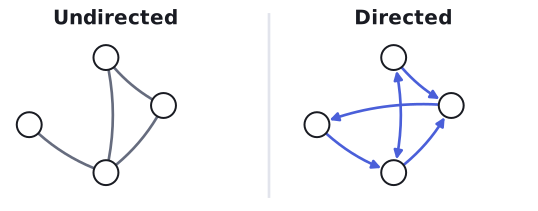
-
Positivity — edge weights can be constrained to be non-negative, either by zeroing negative values () or by exponentiating them ().
-
Sparsity — sparsity can also be enforced architecturally: thresholding low values with ReLU gives an -graph, while keeping only the top- values per node gives a NN graph.
-
Discretization — edges can be made binary via sampling or reinforcement learning. In practice, weighted graphs are usually preferable: they are more flexible and easier to learn, being differentiable.
Architecture
Two approaches are commonly used to compute the adjacency matrix.
- Direct optimization — the adjacency matrix is treated as a free parameter and optimized directly, as in GLNN (Gao et al., 2019).
- Metric-based — edge weights are estimated from node embeddings via a distance metric, such as cosine similarity (Nguyen & Bai, 2011):
where is a trainable parameter, as in IDGL (Chen et al., 2020). Because weights are derived from embeddings rather than stored directly, new nodes can be added without retraining the whole graph.
More expressive metrics can replace cosine similarity, such as attention mechanisms (Veličković et al., 2018). A further extension, structure-aware learning, also incorporates the attributes of the edge itself when computing its weight.
Conclusion
Graph Structure Learning makes graph-based methods usable even when the underlying graph is noisy or missing, by learning or correcting it directly.
This article covered why GSL is used, how it is combined with a network, and the constraints typically placed on the learned graph. The field is active, and what is covered here is far from exhaustive.
This overview draws on Zhu et al. (2022) and Chen & Wu (2023). A future article will experiment with a GSL method in practice.
References
Chen, Y., Wu, L., & Zaki, M. J. (2020). Iterative Deep Graph Learning for Graph Neural Networks : Better and Robust Node Embeddings (arXiv:2006.13009). arXiv. https://doi.org/10.48550/arXiv.2006.13009
Derrow-Pinion, A., She, J., Wong, D., Lange, O., Hester, T., Perez, L., Nunkesser, M., Lee, S., Guo, X., Wiltshire, B., Battaglia, P. W., Gupta, V., Li, A., Xu, Z., Sanchez-Gonzalez, A., Li, Y., & Veličković, P. (2021). ETA Prediction with Graph Neural Networks in Google Maps. Proceedings of the 30th ACM International Conference on Information & Knowledge Management, 3767‑3776. https://doi.org/10.1145/3459637.3481916
Fan, W., Ma, Y., Li, Q., He, Y., Zhao, E., Tang, J., & Yin, D. (2019). Graph Neural Networks for Social Recommendation. The World Wide Web Conference, 417‑426. https://doi.org/10.1145/3308558.3313488
Gao, X., Hu, W., & Guo, Z. (2019). Exploring Structure-Adaptive Graph Learning for Robust Semi-Supervised Classification (arXiv:1904.10146). arXiv. https://doi.org/10.48550/arXiv.1904.10146
GNNBook@2023 : Graph Neural Networks : Graph Structure Learning. (n.d.). Accessed April 10, 2023, from https://graph-neural-networks.github.io/gnnbook_Chapter14.html
Jin, W., Li, Y., Xu, H., Wang, Y., Ji, S., Aggarwal, C., & Tang, J. (2020). Adversarial Attacks and Defenses on Graphs : A Review, A Tool and Empirical Studies (arXiv:2003.00653). arXiv. https://doi.org/10.48550/arXiv.2003.00653
Kalofolias, V. (2016). How to learn a graph from smooth signals (arXiv:1601.02513). arXiv. https://doi.org/10.48550/arXiv.1601.02513
Nguyen, H. V., & Bai, L. (2011). Cosine Similarity Metric Learning for Face Verification. In R. Kimmel, R. Klette, & A. Sugimoto (Eds.), Computer Vision – ACCV 2010 (p. 709‑720). Springer. https://doi.org/10.1007/978-3-642-19309-5_55
Veličković, P., Cucurull, G., Casanova, A., Romero, A., Liò, P., & Bengio, Y. (2018). Graph Attention Networks (arXiv:1710.10903). arXiv. https://doi.org/10.48550/arXiv.1710.10903
Wu, S., Sun, F., Zhang, W., Xie, X., & Cui, B. (2022). Graph Neural Networks in Recommender Systems : A Survey (arXiv:2011.02260). arXiv. https://doi.org/10.48550/arXiv.2011.02260
Wu, Z., Pan, S., Long, G., Jiang, J., Chang, X., & Zhang, C. (2020). Connecting the Dots : Multivariate Time Series Forecasting with Graph Neural Networks (arXiv:2005.11650). arXiv. https://doi.org/10.48550/arXiv.2005.11650
Zhu, Y., Xu, W., Zhang, J., Du, Y., Zhang, J., Liu, Q., Yang, C., & Wu, S. (2022). A Survey on Graph Structure Learning : Progress and Opportunities (arXiv:2103.03036). arXiv. https://doi.org/10.48550/arXiv.2103.03036
Wu, Z., Pan, S., Long, G., Jiang, J., & Zhang, C. (2019). Graph WaveNet for Deep Spatial-Temporal Graph Modeling (arXiv:1906.00121). arXiv. https://doi.org/10.48550/arXiv.1906.00121